Higher Education, Civil Discourse and Democracy
Download MP3Special Presidential Speaker Series – Michigan State University
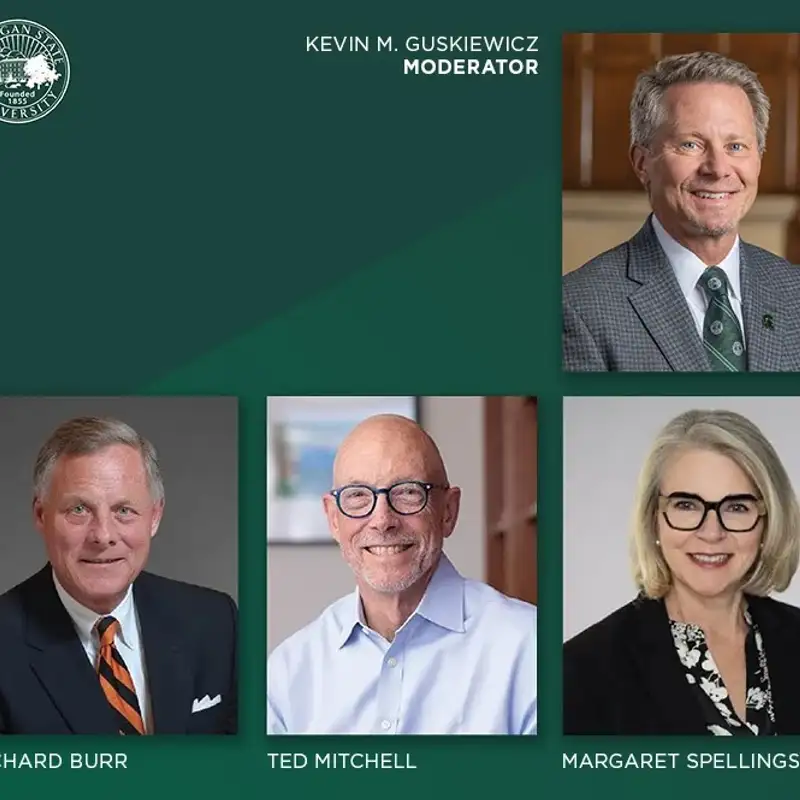
Michigan State University launched its Presidential Speaker Series with a wide‑ranging and candid conversation on the role of higher education in sustaining democracy and civil discourse. Held at the Wharton Center and moderated by MSU President Kevin M. Guskiewicz, the event brought together bipartisan leaders from government and higher education to examine how universities can help prepare students to navigate disagreement, practice democratic engagement, and contribute meaningfully to the public good.
The evening opened with framing from Ann Austin, University Distinguished Professor in the College of Education, who emphasized the importance of universities as spaces where diverse perspectives meet—and where disagreement, when approached constructively, becomes a powerful tool for learning. President Guskiewicz underscored that today’s college campuses are often the first places where students encounter people with markedly different backgrounds, beliefs, and lived experiences, making higher education a microcosm of American democracy itself.
The panel featured three nationally recognized leaders: Richard Burr, former U.S. senator and principal policy advisor at DLA Piper; Ted Mitchell, president of the American Council on Education and former U.S. under secretary of education; and Margaret Spellings, president and CEO of the Bipartisan Policy Center and former U.S. secretary of education. Former Michigan governors Jim Blanchard and John Engler also joined the program, highlighting bipartisan efforts to strengthen trust in democratic institutions.
Across the conversation, panelists explored growing public skepticism toward higher education, driven by concerns about affordability, job outcomes, transparency, and perceived political bias. While acknowledging these challenges, speakers emphasized that most students report feeling free to express their views—and that universities remain among the few institutions designed specifically to foster open inquiry and debate.
A recurring theme was balance: between higher education’s public mission and individual return on investment; between academic autonomy and accountability; and between preparing students for employment and preparing them for citizenship. Panelists stressed that employability and civic education are not competing goals, but mutually reinforcing ones—arguing that student success, transparency in admissions and financial aid, and relevance of research to community needs are essential to restoring public trust.
The discussion also addressed emerging pressures, including rapid technological change, artificial intelligence, national security concerns tied to research and data, and the influence of social media on public discourse. Speakers called on universities to communicate their value more clearly, form stronger public‑ and private‑sector partnerships, and recommit to their role as places where difficult conversations can happen with rigor, respect, and honesty.
Audience questions steered the conversation toward practical action: how to design classrooms and campus experiences that encourage belonging and respectful dissent; how faculty can be supported in navigating charged discussions; and how leaders can remain grounded in core educational values amid political and social pressures.
As the inaugural event in the series concluded, President Guskiewicz reflected on the enduring responsibility of universities to educate not only skilled graduates, but engaged citizens. The evening affirmed the purpose of the Presidential Speaker Series: to model civil discourse, elevate thoughtful disagreement, and strengthen the democratic mission at the heart of higher education.
Transcript:
Speaker 1 (00:00:00):
Good evening. Hello, and thank you so much for joining us tonight. I'm Ann Austin, and I'm a university distinguished professor in the College of Education. I'm very pleased to be here this evening to introduce the Special Presidential Speaker Series and its participants to you. Before we get started, I want to mention a few housekeeping items. First, and in particular to the topic that we're examining this evening, we ask that you please be respectful to those who are joining in the conversation. We also ask that you avoid flash photography or personal recording devices as they may be distracting to those who are on the stage. And we all very much appreciate your cooperation with those requests. Tonight, we're going to be discussing a topic that's quite important to me, and I think to all of us, it's important to me because I've held leadership roles in higher education, as well as being a researcher who studies major issues in higher education.
And in fact, with my colleague, Brendan Cantwell, who I think is here this evening also, we've been hosting a series of public webinars discussing the future of public research universities. And tonight's topic on higher education and civil discourse is really quite central to that future of our universities. Before we delve into the discussion, I first want to acknowledge some of the people joining us in the audience tonight, starting with Michigan State University, Board of Trustees members, Renee Knake Jefferson, and Rebecca Bahar-Cook.
We appreciate having our trustees with us. And welcome also to the state legislators joining us, as well as the presidents of several Michigan universities and colleges and leaders of the Michigan Association of State Universities and Research Universities for Michigan. Thank you so much for joining us. So let's get started with this very interesting evening. Writing in the Lansing State Journal in 2024, MSU President Kevin Guskiewicz said that upholding ideals like civility, respect, and dignity is essential to the meaningful exercise of pluralistic democracy. And he wrote, "The universities like Michigan State are purpose built to promote understanding across our differences." The following month here at the Wharton Center during his presidential investiture, the president announced his intent to sponsor a presidential speaker series. He said such discussions could help our students learn to better navigate a world that's filled with diverse beliefs and viewpoints, bringing thinkers and doers to this campus in an atmosphere of civil discourse.
We know that college might be the first place that many students live and work together alongside people with very different backgrounds and lived experiences. President Guskowitz pointed out that this mix of people and perspectives makes campuses like ours a microcosm of the society into which our Spartans will graduate. This annual presidential speaker series was conceived as a university and a community event, offering attendees and especially our students, examples and role models for engaging in constructive dialogue across difference. By spotlighting healthy tension in the realm of ideas, this series is intended to help illuminate the many ways to view the world and to give us perspectives to help process the unfamiliar and the challenging in very constructive ways. Tonight, we're here to explore the role of higher education and civil discourse and as a crucial support for upholding democracy. I want to introduce today's panel and our moderator, whom I invite to join me here on stage as I introduce each of them.
Moderating tonight's conversation will be Michigan State University's 22nd president, Kevin Guskiewicz.
President Guskowitz is a neuroscientist and a longtime academic leader. He's been with us now for just over two years. We're delighted about that, and he holds a John A. Hannah distinguished professorship here at the university. His leadership at Michigan State focuses on the university's role as a talent advocate for the state of Michigan and beyond, preparing students for the many global challenges and career opportunities of the 21st century. Welcome, President Guskiewicz, and thanks so much for your leadership on this terrific series. Panelist Richard Burr is principal policy advisor at the global law and lobbying firm, DLA Piper. For 28 years, he represented North Carolina and the United States House and then the Senate. Senator Burr is widely known as one of the foremost government authorities in healthcare, life science, higher education, geopolitical risk, and national security policy. His work includes advising major universities, navigating a rapidly changing policy landscape and significant regulatory and political uncertainty.
Senator Burr led initiatives in education and civil rights and conservation policy, and he's also contributed to drafting the Bipartisan Student Loan Certainty Act, which dramatically reduced interest rates for students who have federal student loans. Welcome, Senator Burr. Thank you so much for being with us.
Our next panelist is Ted Mitchell, President of the American Council on Education. Specializing in issues around educational access and outcomes, he works with Congress, the executive branch, and the private sector to develop policies and innovative practices that serve our country's post-secondary learners. He's a former US Under Secretary of Education to President Barack Obama, who, I believe he's a professor also, who oversaw reinstatement of Pell Grants for incarcerated adults, created the college scorecard, and restored millions of dollars to students who were defrauded by their institutions. Ted Mitchell has also served as president of Occidental College, Vice Chancellor and Dean at the University of California, Los Angeles, Professor and Department Chair at Dartmouth College, and a member of the Stanford University Board of Trustees. Indeed, we are very happy. Welcome. We're delighted you're here.
Our third panelist, Margaret Spellings, is a nationally recognized leader in public policy, and she's president and CEO of the Bipartisan Policy Center. She served as a US Secretary of Education under President George W. Bush, and she later served as president of the 17 Institution University of North Carolina system. She most recently served as president and CEO of Texas 2036, a bipartisan think tank. Her extensive leadership experience in state and federal government also includes service as White House Chief Domestic Policy Advisor, Senior Policy Advisor to then Governor George W. Bush, and President of the George W. Bush Presidential Center. Welcome, Madam Secretary.
Before I turn the program over to President Guskiewicz, I also want to introduce two Spartans, whom you might know, to briefly share some of their own very experienced perspectives on the role of civil discourse in our democracy. Just last month, they joined former governors, Rick Snyder and Jennifer Granholm in a public conversation in Lansing, helping launch the Michigan Civility Coalition. Before his association with D.L. Piper, where he is a retired associate, James Blanchard served in the US Congress as ambassador to Canada and is Michigan's 45th governor. John Engler served in the state Senate and as Michigan's 46 governor before leading government affairs for electronic data systems and heading up the National Association of Manufacturers and then the Business Roundtable. And I should also add serving as interim president of Michigan State. Today, both serve on the bipartisan leadership team of the Democracy Defense Project. That multi-state organization is working to restore faith in public elections through constructive dialogue and defending the transparency, safety, security, and validity of our nation's electoral system.
Please join me in welcoming former governors, Jim Blanchard and John Engler.
Speaker 2 (00:10:30):
Thank you, Ann. Thank you, Ann, and thank you for your over three decades of service to Michigan State University. Also, as we start, I do want to thank your parents and grandparents for having supported me as governor. Try that again. We are delighted to be part of this inaugural of your program, President Kevin Guskowitz. We're delighted we've talked about this a year ago. It's now come to fruition, and thank you, Secretary Spellings, for being with us under Secretary Mitchell, Secretary Mitchell, and my colleague at DLA Piper, Richard Burt. Thank you for coming in to see what spring in East Lansing is.
Now, Governor Engler and I do chair this Democracy Defense Project in Michigan. It's part of a national effort, as Anne mentioned. Our goal is to simply, very simply, in our state of Michigan, underscore the fact that elections are fairly administered, run, accurate, transparent, and those who suggest otherwise do a great disservice to the over 1,500 city and township clerks, 83 county clerks, and the voters of our state. Election integrity in Michigan has been safe and intact, and we're proud to say that, and we work as a Democrat and a Republican and citizens and Spartans to make sure our public is aware of that at every turn. And when those who suggest otherwise, we push back because almost all of them know better, but they're playing the conspiracy game and will have none of it. And so I am proud that my co-chair, along with former Congressman Mike Bishop and former Lieutenant Governor John Cherry, that my partner in this effort, important effort, is John Engler.
And I might also say Governor John Engler. We don't always agree on everything. We certainly agree on our elections and the need for civil discourse in America and in Michigan. I would also want to say that John Engler gave 32 years of his life in public service in Michigan. And as his predecessor, I want to thank him. John?
Speaker 3 (00:12:59):
Thank you, governor. Thank you. Well, thank you very much, Governor Blanchard. It's a delight for me to be back on campus to be with celebrating St. Patrick's Day and President Oguskowitz, a little Irish there for the day. Well, we should be able to remember the kickoff because it was a St. Patrick's Day that this series was launched and congratulations to you and all of the folks at the university have been part of putting this together tonight and all of you for attending because sometimes it's hard to bring people out to talk about something good. And this is a very good thing we're doing here tonight. And this panel is extraordinary since Jim named everybody. I won't do it again, but three friends all who I've known in DC and in Texas for a number of years, Jim's right, the Defending Democracy Project's something that we're very proud of.
One of the things that was important to us is to look at how people viewed the elections. And so we did some survey research, which I think is important. We've got a lot of people interested in data here, but the data showed as we surveyed people in Michigan, when they understood that you do show an idea to vote, that we do ask you to be a citizen to vote, that we do ask you to vote only once, and that we have controls when there's a problem, and we have ways to deal with that. And in fact, our local clerks have done a pretty splendid job of that. And so over a lot of years, over a lot of elections, and I've been in some close ones, I've been around some other very close ones, Michigan's always had a pretty good reputation. And the defense of democracy is really boiling down to this.
We want elections to matter. We want everybody who's eligible to vote to vote, vote once, but vote and get your voice heard because I think there's never been a time when it's been more important to speak up and speak out and participate. And so we want you to know when you do that, you're doing so in a system that cares about you and it cares about your vote. And we're going to make sure that people understand. And when they do, the data shows there's tremendous confidence, 80%, and it's across all parties. It wasn't just Republicans or Democrats or Independents. It was across all that had confidence in the Michigan system. So we're confident in you. We're confident in our states carrying out the elections, and we're certainly confident in the leadership of Michigan State University to bring us together tonight for such an outstanding program.
Thank you, Mr. President. Thank you.
Speaker 4 (00:15:37):
Well, thank you. Thanks to all of you for being here to celebrate St. Patrick's Day with us. And I want to thank Anne for your wonderful opening remarks. I want to thank Governors Blanchard and Governor Engler. I could not have two bigger supporters than the two of you. It means a lot that you'd be here tonight to help us kick this off. There's also one more thing that the two of them absolutely agree on, and that is Michigan State University and you love ... Okay, great. So here we are and thrilled to have three close friends and I think it's going to be a lot of fun tonight. We have some questions from the audience that have already been sent in toward the end of the program, but I'm going to kick it off with some questions that'll be open to our three panelists. And I want to start by just saying that universities are special places.
I've had the privilege now of leading two great public universities over the last roughly seven and a half years. And universities play a unique role in American democracy as places where ideas are tested, where disagreement is part of learning and where academic freedom is essential to preparing the future leaders and to be sure that they can become active citizens in a thriving democracy, one that's important to us, but it's part of the discovery and learning part for our students here. And so I'm going to start off with something that John Hannah said and John Hannah served as Michigan State University's president from 1941 to 1969, from World War II to the moon landing, I've been asked, he did 28 years, Governor, are you going to try to outdo them? And you can ask my wife, Amy, that's over here somewhere, what she thinks about that.
We're having fun, but I'm not sure I got 29 years in. But John Hannah, in 1960, told the American Council in Education, Ted, you might have heard of this organization. I have. At a gathering in Chicago, we who believe in the dignity of the human spirit must preserve educational values for what they can do both for the individual as an individual and as a citizen of a free nation. Hannah maintained that training engaged citizens technically and ethically fit to sustain American democracy is the most important function of universities such as Michigan State University. Let's fast forward from 1960 when President Hannah said that to 2021, writing in his, at that time, new book, What Universities Owe Democracy, John Hopkins President Ron Daniels, a good friend, warned that the academy is abandoning that role. So in his writings, he talks about questions that university leaders and faculty should be asking.
"What is our obligation as educators to our democracy? What or how do you think colleges and universities should teach along those lines and what responsibility do public universities have to model and sustain civil discourse as a means to these ends? "So turning to our panelists, thoughts about the role that American universities should have to these obligations and responsibilities around democracy and to Ron Daniel's point, have we abandoned it?
Speaker 5 (00:19:13):
I'm still trying to get over the fact that you only get to vote once in Michigan.
I think you guys are wrong on this, Tommy. I mean, Governor, Kevin, I don't think anything's been abandoned. I think that higher education especially has become such a focus in this country and in large measure because they've been criticized for the way they used federal partnership. Now, this school in this state produces $10 billion worth of annual contribution to the economy, but this school also invests a billion dollars in research, of which 50% of that comes from the federal government. And I think what we have to do is we have to right size the relationship between the federal government and higher education.
When it's tough to criticize you on the partnership, even though that's what they're concerned with, then they criticize on everything else. And I think we've gone through a period where there have been changes to policies that have been in place for so long. And one of the toughest things to explain to people is that the federal government has the right, as Margaret knows, to say one thing 10 years ago and another thing now, it's part of life and we adjust to it. And that's part of a political system too. Like you see two governors from two different parties get together over a common issue, but we can never eliminate the ability for our youth who come in to experience all facets of conversation because that's part of the learning experience. I think about the United States where you have the freedom to say anything you want to anywhere you are, in most cases.
In London, you get to stand on a box in a park and speak, but that's the only place that you get that freedom. So different countries apply it differently. And I would tell you that ours has evolved into what it is where the college campus is the place where people grow in more ways than just physical.
Speaker 4 (00:21:38):
That's great. Thank you.
Speaker 6 (00:21:41):
So I'm feeling outnumbered as the Yankee here surrounded by North Carolinians. So if I go off the surfboard, let me know.
Speaker 5 (00:21:52):
No, I'll keep you there.
Speaker 6 (00:21:53):
Thanks. So I think that something changed that has heightened the controversy about the partnership and it has called what we're doing moving backwards. I'm not sure we've moved backwards either. I think one of the things that's happened over the last 20 to 30 years is that we, as a community of Americans, have begun to see higher education solely as an individual good and not as a public good. And so we need to change a little bit about that dialogue before we can truly accept our responsibilities to serve democracy. We could serve democracy, but if no one was paying attention, that wouldn't necessarily be good. So as a result of that big shift between public and individual, we have used almost all of the collective and individual measures that we have to identify higher ed success by aggregating individual success, US News and World Report, even the Carnegie classifications that we're responsible for, ROI discussions where we're seeing in Congress now, there will be a floor below which student earnings will lead to an institution not having access to federal funds.
I support all of those things, but I don't support them at the expense of thinking about the public good. To Richard's point about campuses being the place where that happens, we'll get into this more, but John Dewey, the great American philosopher, said that democracy is less a political apparatus than a form of associated living. And this is the place where we have to practice that. This is the place where we have to practice that. That's the fundamental start. Thank
Speaker 7 (00:23:51):
You. I just want to add that the public universities uniquely and especially are on the front lines of that because obviously we're all supported with state and federal public dollars. And the reason that the Congress and others, policymakers like me and Richard have been talking about the value proposition and the value for the individual is because most of the people who are sending their kids to college want to know they can get a JOB when they're done with often a lot of debt, even in public universities. And so that's table stakes. We got to keep the main thing the main thing or else they're not going to be here for us to instruct them on the niceties of democracy. And they are the niceties, obviously, and the bedrock of our society. But I think for us to overlook why that is, and that is ... We are on the front lines of these things, but the frustration is not, "Oh God, why aren't these people teaching our kids more about democracy?" No, they're worried that they've got a lot of debt and can't get a JOB.
And so we got to ring the bell on those metrics in a big way so that we can have this other conversation, keep the main thing the main thing, as I like to say. I
Speaker 4 (00:25:08):
Agree. I like it. And I don't know if you know, but Michigan State University ranked two consecutive years among the top 10 public universities in the country for employability ranked by times higher ed. And I'm careful about rankings and where you sit because just as you go up two or three, you can go down one or two and then you have to explain that, Richard. But that one, we're incredibly proud of and we'll continue to because it is important. I'm really proud of what we're doing and we have incredible faculty and staff that make this all possible. Let me flip gears and switch gears just a little bit. Here at Michigan State, and I'm sure at many other colleges and universities, we hear rising faculty and student concerns about federal attempts to infringe on freedom of expression and academic freedom. For example, the administration's 2025 compact for academic excellence in higher education tried to persuade universities like ours to accept restrictions on admissions and hiring, international enrollment and programming that could be viewed as belittling conservative thought in exchange for preferential funding.
So I'm curious if any of you would want to opine. Do you agree with the compact's critique of higher education regarding our responsibility to offer a vibrant marketplace of ideas where any parts of the compact you might agree with or disagree with?
Speaker 6 (00:26:36):
So having never spoken about this publicly before.
Speaker 4 (00:26:40):
Right. Yeah, right.
Speaker 6 (00:26:43):
Throw a couple ideas out. So let me stipulate first, the things that the compact is aimed at are not things that we do particularly well. And so guilty is charged maybe with lower case letters, not all caps, but I want to go back to what makes a university a university and not a media company or a law firm, or I'm just making these up. They're just random. Other kinds of institutions in society that have also been asked to make compromises in favor of either preferential treatment or getting out from a penalty. Felix Frankfurt helps us out with this in 1957. And by the way, these issues of who teaches what and whether you're going to left or to right. 1956, the University of New Hampshire fires an economist named Sweezea who then appealed and it was because Sweezea was teaching Marxism at the University of Vermont, which explains a lot about Vermont.
Speaker 7 (00:27:55):
He's still there.
Speaker 6 (00:27:56):
He's still there. One of his students is, and so Swayze appeals all over the Supreme Court, and Sweezea wins. And Felix Frankfurter said, "For a university in America to be a university, it has to have four freedoms, four essential freedoms." And I agree with that. One, the freedom to decide who to teach. Two, the freedom to decide who teaches. Three, the freedom to decide what to teach, and four, the freedom to decide how to teach it. I would add a fifth. This is something that Senator Burr and I have talked about over the years, what to research. And so I think that that has become much more important since 1957. So for me, those are the red lines in today's discussions, the assaults on higher education. Do they cross the red lines? And I think that the compact is a perfect example of something that the federal government wanted institutions to agree to that crossed almost all of the lines.
And again, doesn't mean we shouldn't work on more transparent admissions processes, taking care of affordability, working hard to create ideological diversity on our campuses and places where that could happen. All of those things are right, but the federal government is not the group to tell us that. If they do, we risk becoming instruments of that state. And I don't care if that was Barack Obama or Donald Trump, both are wrong because they undermine the fundamental intellectual autonomy of universities, which is the source of our freedom to build, to teach, to invent, and to inspire. And so sorry to go off on a little bit of a rant, but it really, for For me and for the American Council on Education, protecting those freedoms is where we draw the line.
Speaker 7 (00:30:08):
I'm going to amen on almost all of that and just note that it's a political document, simple as that. And the things that were in there, the mechanical, how do you do it? Freeze tuition for five years. Richard, you know in North Carolina, we froze tuition for longer than that and all of a sudden we needed a tuition increase. And so we're going to sit in Washington DC and say, "You do this, you do that. Who you can admit, what test you're going to use, how much you can raise tuition." No. I mean, from the people who are going to return all this to the states, and by the way, most of the institutions we're talking about here are largely funded by tuition and the good taxpayers of the state of fill in the blank. And so just as a mechanical matter and a practical matter and a he who has the gold makes the rules matter, it doesn't make sense.
Speaker 6 (00:31:02):
Can I say two quick amendments to my own statement? I think I need to remind all of us that those freedoms exist within two boundaries. One is the law, and two is a set of responsibilities that go along with that, that I know we'll get back to when we talk about intellectual academic freedom.
Speaker 5 (00:31:20):
Let me just add one component to it. This is a marketplace. I mean, students have a choice of where they apply and of the ones where they're accepted where they choose to go. And I'm not sure that Washington is the fear that I have long term. I think the fear that I have long term is that the system is going to change so quickly that the enterprise that's here and in North Carolina can't change that quickly. And I think of the story about Steve Jobs, the guy in the garage building a computer. I envision the guy sitting in a garage today with an AI tool trying to figure out how to provide a higher education dump in two years that exceeds what you can do in four years under the structure because of the limitations you have in flexibility and where post COVID, you'll have some parents going, "Oh yeah, yeah, yeah.
I like this. This is much more cost effective, the return on investment." And to Margaret's point, likely very targeted at only areas that have a JOB. So I think the competition is not just other institutions going forward. I think it is a change in the system. And I think that's what will help moderate what happens on the campus. It shouldn't be bureaucrats in Washington.
Speaker 4 (00:33:04):
Great. You practically have answered my next question, Richard. Were you looking at my notes? No. I essentially was going to ask how has the expectation that universities serve as protectors of academic freedom and of a marketplace of ideas where that exposure to disagreement is central to education changed? How could one expect that it should change? And I'm hearing you say that we've got to sort of stand our ground, but there's choice in
Speaker 5 (00:33:33):
This. It's going to change. I mean, that's a certain ... But I want to hit on something that Ken said. Transparency in applications is a problem. Yes. Totally. And I will tell you, I do not have a solution to it, but when an alumni, a parent, when a student knows on paper that they qualify to get in, but they get rejected, that's where the system begins to break down. And listen, you can't accept everybody that applies, right, Margaret? I think you taught me that. And she knows better than anybody because she came from a university system that had a tremendous amount of applications for every slot that was there. And it's gotten even more mysterious as to how students are picked.
Speaker 6 (00:34:34):
So let me build on that. I think that transparency is really important and I want to expand it a little bit. We're going to talk about a lot of highfalutin ideas and academic freedom and freedom of discussion, and that's why we're here. But I spend a lot of my time trying to decode why America hates us. And I'm not sure that they do. I was just being hyperbolic, but certainly more Americans have lost trust in higher education over the last 25 years than in the last 50 or 100. And we can talk about a lot of big ideas, but I want to endorse JOBS and I also want to talk about transparency. I think we're losing the battle for Americans spirits in the bread and butter blocking and tackling, sorry for the sports metaphor, work that we do. If you think the system is rigged, and it's not just you have an equal set of A's and B's, but legacy, athletics, name all of the other ways in which people think that they don't know how to play the game.
You lose a ton of people who think higher it isn't for them because it's rigged. It's not for them.
Add to that, the way we talk about price and cost. I'm not talking about whether it's affordable or not, but the instant that you say to an applicant, "Oh, don't believe the sticker price." It's really not going to cost you $92,000 to go to Columbia. It's likely to cost you about half. What that says is you got to bargain for the other half and how you do that, nobody knows. So you're going to lose people that way. And then, and I'll stop, I promise, you get your acceptance offers and you get these things called financial aid offer letters. We did an analysis two years ago that 35% of those offers don't distinguish between a grant and a loan.
Speaker 7 (00:36:34):
Yikes.
Speaker 6 (00:36:35):
I mean, that's a better business bureau thing. That's not ... Yeah. But imagine first generation family, you sign up to go to institution X. There's a line that says aid. It says $15,000. You sign up and you're on your way and you realize that you've just signed a $10,000 note.
Speaker 7 (00:36:56):
And why people have lost faith in us.
Speaker 6 (00:36:58):
And
Speaker 7 (00:36:58):
There you have it. So
Speaker 6 (00:37:00):
Really? Yeah. Why would people have faith in us if this is our introduction? Yeah. They haven't even set foot on campus yet. And we've dinged them three times about whether we're trustworthy, whether there's integrity in the system.
Speaker 4 (00:37:13):
Agreed. Margaret, you had another thought on this topic?
Speaker 7 (00:37:15):
I can't even remember what it was after that.
Speaker 6 (00:37:18):
Because Ted talks all. Not really.
Speaker 7 (00:37:20):
I mean, it'll come to me though.
Speaker 4 (00:37:23):
Let me just, since you brought up the JOBS, I'm going to start using that and I'll spell it out. Just like AI, right?
Speaker 7 (00:37:29):
Yeah, right.
Speaker 4 (00:37:31):
But I sit on this council for competitiveness in DC. We talked a little bit about that alongside 13, 14 other university presidents and business leaders. And it is my job as a university president to advocate for the value of a four year college degree and even more than that for those that want to do it. And that the success of our graduates, communities and nation are dependent upon giving us a chance. But again, as Ted said, if you look at the Gallup polls, you can look at just by any poll. I mean, Americans are losing confidence in us. Who has to help tell our story? We sat around that table in DC three, four months ago, and we said, "If we write our own compact on this and I'll sign it, these 14 presidents, it sounds self-serving, but who else do we need to be out there advocating to advocate for us to talk about the value of higher education?"
Speaker 7 (00:38:28):
Well, the people who are paying the bills for starters, the kind of folks who are not vested in the system, not on the payroll of the university per se. So I think that's a good place to start. And this gets, and you and I can get into this a whole other session, the governance of American universities is a mess. Amen. And I say we got to get organized for success. We are not organized for success. And in my view, going back to the days, and you introduced me to one of your colleagues where we have appointed boards of the most high competency, high value civic leaders in our country, that's kind of off. We don't do that anymore. It's very political on both sides of the aisle. It's sensitive to things other than the mission of the university. And I think that has been a hugely corrosive influence on, and part of why we're here now, honestly.
Speaker 5 (00:39:27):
Yeah. Kevin, I'm going to see if Ted and Margaret agree with me on this. There are two reasons that a university goes to Washington. They're either there for request for appropriations or they've been invited for an interview.
Speaker 4 (00:39:45):
I'm glad I've only done the former.
Speaker 5 (00:39:50):
Let me just say this, that I deal with business, I deal with academia, I deal with all sorts of clients. The thing that people need to understand about Washington, especially today, is they need to be educated.
Speaker 7 (00:40:08):
Yes.
Speaker 5 (00:40:09):
They need to be educated on what businesses do. Do you think that there is a pool of people in Washington that work at a staff and member level that understand AI, but they're going to do the policies and the regulation on it? Yeah. And I say to AI companies, "Give me about three months of you with me in Washington and let's go educate some people. " When's the last time that higher ed did that? It's been a long time. And there was a point in time where it was sort of constant, but there's not a better platform for emerging technologies than the higher ed community individually to go up and educate, start with your members of the Senate and the house and expand that out and have a compact with universities of like mine to go to Washington do the same thing. If we begin to educate them about what you actually do on a college campus and what you're faced with and what your margins are, all of a sudden the problem that you've got today sort of diminishes greatly.
Speaker 7 (00:41:10):
And Kevin, I know you do this, and you talked about the number five point research. People want research that is in service to the needs of their state for public policy, their own. So- And
Speaker 4 (00:41:24):
Their businesses.
Speaker 7 (00:41:24):
And their businesses. And so what an amazing value proposition, yes, to educate, but here is how we're solving the most critical challenges before us.
Speaker 6 (00:41:34):
So I spent a lot of time on the road and sometime literally on the road, I drove through Kansas over the summer. University of Kansas and Kansas State have a wonderful billboard campaign. It changes by county. And on the billboard, it talks about the research that has impacted the county and how.
Speaker 5 (00:41:52):
Cool.
Speaker 6 (00:41:53):
Sometimes it's about machines, sometimes it's about agriculture, sometimes it's about teachers, but they're actually kind of bringing that home. We're pretty self-satisfied. Senator and I were talking about this earlier, that especially most elite universities feel that they don't need to make those connections anymore. And so they do things like my favorite are the halftime videos. How many of you get your refreshment before the halftime video comes on so that you can be there, right? Yeah, zero is the answer. But somehow that fills in for telling our story and that's just not going to cut it.
Speaker 5 (00:42:36):
It's not going to cut it.
Speaker 7 (00:42:38):
Well, and we're letting Harvard and Columbia Duke. You're getting plugged
Speaker 5 (00:42:44):
Home now.
Speaker 4 (00:42:47):
She had to get that in.
Speaker 7 (00:42:48):
You mentioned, I mean, we're letting the elites tell the story of American education to the extent it gets told at all, not Michigan State or UNC or Appalachian or Western or wherever. And so I think those of us who are on the front lines, supported by public dollars from top to bottom essentially and tuition have the best messaging and we seed it to the elites and now we're spending all our time defending the stuff they're doing.
Speaker 6 (00:43:19):
So Michigan State, we're profiling Michigan State this week on our website and our campaign, Higher Ed Builds America. I don't know how Michigan State got on the docket for this week, Kevin. Well done, Ted. But it's pretty cool. It's a perfect example. It's a faculty member who is, after a long period of research, looking at neonatal to first year development of kids, says, "We do pretty well on neonatal. We suck at zero to one." And so let's put together public private partnerships to help families bring their family into being with professional and financial support. Thank you, Michigan State. That's the kind of thing that we need to be doing and talking about.
Speaker 5 (00:44:10):
Agreed. So now that Ted's got us some things that suck a little bit.
Speaker 6 (00:44:15):
That was the technical term?
Speaker 5 (00:44:17):
Okay.
Let's face it, K through 12 is broken in this country, period, end of sentence. And somehow we're expecting that higher education is going to flourish when the preparatory school is totally broken. I don't have the answer for what the fix is, and it's not something that has a federal component to it, but I would tell you that the start of what we ought to be looking at is 50 states committed to fix K through 12. So whether they choose to go to college or not, at least we have individuals that have the capacity in the rest of this century to be able to go out and find a JOBS because we're literally 18 months away from a lot of the jobs we encounter every day being replaced by a robot. It's already there. And from a standpoint of competition, it's going to happen and it's going to dislocate people.
And North Carolina, Margaret knows this, that when textiles sort of went through their transition and we decided that the state incentive was going to be an education package for all of the dislocated workers, what we found was roughly a group of people that were 55 years old with an eighth grade education. And this came down to a mathematical calculation. Should we spend money to get them a GED so they can get a JOB or should we just take care of them until they get 65? And given the timeframe, the decision was made, let's pay them until they're 65 and then they have a check coming in. So we don't want to set ourselves up in the same situation as we go through this transition in the economy. It's real, it's going to be impactful. It's going to be 10 times, I think, what most project it's going to be.
Speaker 4 (00:46:16):
And sadly, there's a lot of competition right now for state appropriation. There's a battle between K-12 and higher ed, and there's only so much in the pot in terms of to spread out, and there's this debate. And I don't want it to get into that, but we have to find a way to ... Money's not going to solve all the problems there.
Speaker 7 (00:46:33):
Can I say what ... I can't be silent on this. I'm so sorry. In the 16 years of Bush and Obama, we were going in the right direction. We really were. We were closing the achievement gap. We were moving in the right direction. We were focusing with accountability on reading and math. Don't take my word for it. Look at the national report card. Before COVID, it started going down. Then COVID, then Biden, then Trump, and we've been going down ever since. And so we do know how to use a federal role in a smarter way. It's not about particular inputs. It's about who do we care about? How do we find out? And what do we do about it when we know?
Speaker 4 (00:47:11):
Yep, you're right.
Speaker 6 (00:47:13):
Sorry
Speaker 7 (00:47:13):
For that little-
Speaker 6 (00:47:14):
No, so this is-
Speaker 7 (00:47:16):
Intervention.
Speaker 6 (00:47:16):
People expect Margaret and Ted to disagree on things about K-12. 100% agreement. Standards. This is what it's about. It's about standards. We have lost the ability to set and agree upon standards with consequences, and that's not just K-12. I think that's a lot of where we're headed in reasonable policy making at the federal level for higher education. Let the means sort themselves out. Let people have choice about where they go and what they do, but let's hold the line on what we demand will be the result. And JOBS, job ready has to be one of them.
Speaker 7 (00:47:56):
And transparency
Speaker 6 (00:47:57):
Also. Transparency.
Speaker 4 (00:47:58):
Agreed. So let's go back a little bit to something Ted said earlier, and that is about some of the gallup polling and why Americans are losing confidence in higher ed. I mean, cost of attendance is right there among not preparing graduates for the jobs and careers of today and tomorrow. And then the third one I want to get your thoughts on, and that is the liberal bias that is there in higher ed, at least the perception that it is. Many of the critics against higher ed involve perceptions of liberal bias, suggesting that there's an environment where conservative students and faculty fear to express their opinions, instances of student groups trying to shut down controversial speakers has probably added to this perception. Yet, perhaps surprisingly, the data do not support it. The most recent Gallup Illumina Foundation survey shows that just 2% of all college students say they feel that they don't belong on their campus due to political view is only 2% feel that way.
When stratified by political affiliation, only 3% of Republicans claim that they felt that they didn't belong for those same reasons. And while 38% of Americans with low confidence and higher ed site campus politicization, as a concern, 70% of college students agree they can express their opinions freely on campus. So the question, is this a situation where the silent majority is mostly fine with higher education, but the loud voices on either end of the ideological spectrum make it feel like no one is pleased?
Speaker 7 (00:49:45):
Richard, you should start with that one.
Speaker 5 (00:49:50):
I'm still stuck on his word politicization. That's
Speaker 4 (00:49:53):
A tough one to get out.
Speaker 5 (00:49:54):
No, well, I think about it from a standpoint of the campus being accused of it when for a state school where Margaret was, possibly where you are. I'm Michigan property owner, but Tommy was nice enough to raise my taxes on me as an out- of-state property owner, so I can't afford to go there very often. Oh, I said, Tommy, I said Governor Engler, excuse me. You
Speaker 4 (00:50:19):
Gave me the keys to it. I'll check on it every now
Speaker 5 (00:50:21):
And then for
Speaker 4 (00:50:21):
You if over on the lake.
Speaker 5 (00:50:24):
Sorry, John. But what's political is the way states look at their university system that they own.
Speaker 6 (00:50:34):
Yes. Right. Yes.
Speaker 5 (00:50:35):
I mean, Margaret's been through this. There's a hell of a lot more political in how they want the structure to be, how they want the process to work. And there's no association with Michigan. This is about North Carolina and it depends on who's in charge, who gets elected. The system has to change because the people who control the purse ring say it has to change. So to say that you can separate politics from most of it, you can't because so much of the higher education is state supported systems in this country. And I can't in any way devalue the importance of the federal government as a research partner. It's a different percentage with every institution you look at, but it is a crucial gap that can't be filled on an annual basis because it has to compete with NIL, I think. I'm surprised it took us that long to bring this up.
Speaker 4 (00:51:42):
Oh, we're going to get there. Yeah. Yeah.
Speaker 5 (00:51:45):
But the reality is that everything about the system now has the opportunity to be politically driven. So I'm not shocked that some would claim that that's why there's an imbalance on the campus or that some are treated differently than others. At the end of the day, Kevin, I think that higher education has to begin to find commercial partners too, that the federal government cannot be the only one. And somehow higher education has to convince commercial partners that there's a lot of work that you can do that's advantageous for your research bench, that reduces the cost of their research bench, that produces potential commercialization opportunities for them. And I think given that we're headed into a whole new period of technological innovation, the system's never been more primed for that type of partnership. Yeah.
Speaker 6 (00:52:48):
And they exist, right? Yeah. So the University of California, many of their campuses have privately funded or organisms that look a lot like the NIL collectives where the money is spent on research projects at the bench level. So we kind of know how to do it, but I agree 100% we need to do more of that if for no other reason than to spread the ... And to put pontoons on our boat of people who will support us when the chips are down. So I think we need to do that. Stop.
Speaker 7 (00:53:24):
Kevin, to answer your question, I think it's probably overstated. I'm going to tell a little story about that. But then to Richard's point, kind of so what? Deal with it. I mean, we are at the pleasure of these taxpayers and the governing apparatuses, apparati that we are beholden to. And so we're going to ride the wave. The stronger's going to tell is I was the president at UNC when Trump got elected the first time, and Frank Brune and I taught a political science class the night before the election, and he was bold enough to say, who are you going to vote for? It was a room not much smaller than this, honestly. And tons of hands went up for Donald Trump, a lot of girls. And I thought, Donald Trump's going to win this thing. And this is at the UNC, at the flagship, whatnot.
Speaker 5 (00:54:15):
Liberal institution.
Speaker 7 (00:54:16):
Yeah. Yeah. Yeah, exactly. Woke, liberal place, et cetera. The controversy over bathrooms and silent Sam, Confederate monuments. Folks, spirited debate is alive and well in American higher education from my point of view.
Speaker 6 (00:54:32):
And can I ... I'm going to go one step further and let's normalize it. Education as a thing is about creating the future. People have very different views of what they want that future to look like. And education, public education is one of the few places we actually get to fight about it. We do it in our families. We can do it at city council, but public education from K through PhD is the place where these things come to rest. So I don't like a lot of what I hear, but it happens and it's going to happen over and over again. My little thing comes from ... I was president of a tiny little liberal arts college in LA called Occidental. Occidental was formed as a Presbyterian college. In about 1910, some of the faculty felt that Occidental was wavering a little bit on this Presbyterian stuff.
And so they started knocking heads on the campus and they started to get the trustees involved just like we would now. And they broke away and they created the Bible Institute of Los Angeles, which is now for those of you who keep score, Biola University. So look at the Midwest, all of those sectarian liberal arts colleges, that was a result of a schism of some kind on some campus that brought new institutions into being. I think that we may see another
Speaker 7 (00:56:06):
Moment
Speaker 6 (00:56:07):
In which new institutions are brought into being to satisfy the demands of some portions of the electorate. So I want to normalize it for all of you and say that if you want to visit Biola, I'll give you the chef's tour. Or go see the University
Speaker 7 (00:56:24):
Of Austin in Austin. Or the University
Speaker 6 (00:56:28):
Of Austin, that's right.
Speaker 5 (00:56:29):
And Kevin, I think you were in North Carolina when Montreat Anderson college was getting ready to go out of business and they hired a pretty dynamic president to come in. Student body had gone below 200, small little place up in the mountains of North Carolina. And I remember getting a call from him and I said, "What are you going to do to turn this around?" He said, "I have one major." So what's that? He said, "Cybersecurity." The college is thriving, has about 400 students a year. Every student has a job offer before the end of their junior year. Why? Because they offered a very focused education in an area that they knew there was a JOBS at the end and the attraction was that people came from all over the country. And I think we have to recognize the fact that students are pretty smart before they come and they ... The one thing that's different than when I chose where I was going, kids today choose where they want to live and then they decide the school they want to go to because they want to go to school where they're going to stay.
And clearly that happens here because over 50% of your alumni live in Michigan and he gets cold here. Did you know that? So there's a real desire on their part to stay here and they get the education here, but in this next generation, they're all making this decision and you're seeing a geographical shift that I don't think we've ever seen in the history of this country.
Speaker 6 (00:58:15):
Yeah. So this is why we built the college scorecard, is to be able to give people insights into what the college would be like. And let's remember, the US financial aid system is the largest voucher program in the world. And like voucher programs that actually have enough information, people are going to make choices based on those, but we need to give them the information about jobs among other things.
Speaker 4 (00:58:40):
That's great. Okay. We're going to do a few more and then we're going to bring Anne up back up to bring in some of the questions that have been sent in from the audience. But I want to switch gears a little bit. And Ted, I think they gave you that because I think your lapel mic may have gone out, so I think that's why they handed you the mic.
Speaker 6 (00:58:57):
I thought that
Speaker 4 (00:58:58):
... Yep. So I've long believed that the diversity of lived experiences is crucially growth inducing here on university campuses and within the university culture. And so I want to ask whoever wants to jump in on this, can you recall an instance, either back in your own school days or in an early leadership role that you held where you found yourself shifting your position when you thought you knew the answer to something that you were dug in on maybe a vote, Richard, or something, I don't know. In your mind, you knew where you were, but yet you, because of having been exposed to these different viewpoints, which is what we're here talking about tonight, you changed your own opinion or viewpoint.
Speaker 5 (00:59:51):
The short answer is yes. I think the long answer is if members of Congress serve And make no attempt to hear both sides of an issue so that they feel that they've made an educated decision, then they ought to be removed. I mean, in life, in business, you're paid to educate yourself to make the best decision on behalf of the company. Why would members not do that from a standpoint of policy and regulation? And as I said earlier, we're headed into two decades of the most unbelievable change we've ever seen. And when I got to Congress in 1995, the first big issue I had to deal with was, are we going to tax the internet? I can remember this debate as a member of the Energy and Commerce Committee. And Governor Blanchard, I know yours was the emergence of the radio, but this was ... But I remember the bipartisan debate we had in the energy commerce committee, and unanimously we all decided we weren't going to allow taxation of the internet because we wanted to let it grow into what it could be.
And 17 years later, 16 years later, we taxed it. And somebody asked me why I changed my mind. I said, "Because I still don't know what it's going to grow into, but I think it's healthy enough to live on its own." And the truth is we're going to go through a lot of issues like this where it's not clear what you do. And in the absence of being clear, you've got to do the education to make the right decision.
Speaker 7 (01:01:38):
And furthermore, you need to recognize when it's time to change your mind and fix what you did in the first instance. And sadly, our Congress is so ... What's the right word, Richard? Slow to move.
Speaker 5 (01:01:53):
Ostrich light.
Speaker 7 (01:01:55):
Yeah. That it's not responding to things. Although in something like that, I mean, what would you have them do to regulate AI? Not a good idea because we don't know.
Speaker 5 (01:02:05):
Well, it's a great example, Margaret, because the European Union went out and automatically regulated AI and all the capital in Europe flowed to the United States. It was the biggest win for AI in the United States was the EU doing regulation. Absolutely. And the next week they were calling us trying to figure out how do we back up what we just did?
Speaker 7 (01:02:25):
Yeah.
Speaker 5 (01:02:26):
And the truth is, you don't get do overs, Kevin. When you mess it up, you sort of got to muddle through it and wait for the next one.
Speaker 7 (01:02:33):
Kevin, you were there. The issue on the Confederate monuments, when you really saw how ... I mean, I came from Texas, we didn't have a heck of a lot of them. I mean, obviously North Carolina, et cetera, and how intense the feelings were on both sides and how really in many ways ... I mean, it was legitimate. I mean, family members and just ... I don't know. To me, that was a clarifying debate just because you could see how intensely, personally, emotionally felt those issues are on something that if you just did a poll in the room and said, "Raise your hand in Michigan," people would say, "That's a no-brainer." But to understand what was under the hood on those issues really was compelling for me.
Speaker 5 (01:03:19):
That's great.
Speaker 6 (01:03:19):
So for me, I came to the Obama administration from a stint providing support for ed tech companies and education organizations that were starting up. So it was startups for the good of K-12 and we were doing some higher education work as well. And so I started to do work with for- profit, higher education entities. And so I bought the whole thing, better access to capital, more flexibility, easier to recruit students because we have a different mindset. And I remember that one of my very first meetings was with the presidents of the four largest for- profit companies in my office, in the department, talking about how we could move to make it easier for them to expand. Boy, was I wrong. And it took about 20 minutes of study, listening to members of Congress who had been working on this for a long time, to really understand that that wasn't even a good story.
And so I went from being hospitable to being violently supportive of students who had been really defrauded by these institutions over time. And we were able to close the biggest four of them. That was a good thing, but I'm still really quite ashamed that I had taken in so badly.
Speaker 4 (01:04:58):
Great. Thank you. Great, great examples. I'm going to go one specific question for each of you and then Anne's going to come up. We're going to go a few minutes over. I'm going to take the privilege of saying we're going to go a few minutes after eight since we started a few minutes late.
Speaker 6 (01:05:12):
You are the president.
Speaker 4 (01:05:13):
I am the president. That's right. You'd be surprised what I know. You'd be surprised what I don't have control over though.
Speaker 6 (01:05:21):
Thank you for your attention to this matter.
Speaker 4 (01:05:27):
Senator Burr. We were talking right at the end of dinner about the first time I met you. I had just become chancellor at UNC Chapel Hill. It was in April of 2019. I was at the AAU meeting in DC and you and Senator Warner came up classified briefing with all the leading research universities in the country. You've also been part of, and I'm going to get to that. You've also been part of congressional inquiries into matters of free expression on campus and also matters of security and protecting intellectual property on American campuses from foreign appropriation, which is why we were getting that briefing that day. Do you see areas where matters of expression and civility should take a backseat to matters of national security?
Speaker 5 (01:06:21):
Yeah, that's a great question.
Speaker 4 (01:06:23):
You had great answers for us that day. You scared me a bit, but ...
Speaker 5 (01:06:28):
Well, listen, I look back and that's still something, and Ted remembered it too, because he was in one of the sessions. We briefed over 470 college presidents and chancellors in an unprecedented way. We made sure that everybody had a full day's clearance, and we brought classified examples of why we had a concern with the penetration specifically of China into higher education into the United States. And I think I can say this, it was on multiple fronts. This was not a single rifle shot at a university. This was a multitude of programs designed to not only influence, but to penetrate, to extract intellectual property, and it presented a tremendous national security concern to the country, but Mark and I believed that it was our responsibility to at least let the chancellors and the presidents know and feel confident that they had seen the information that was needed to make the case.
It did make an impression on you, but I remember one North Carolina president who as he was leaving the room, looked at me and he said, "You don't understand. A Chinese professor is my head bench researcher." And I just sort of looked at him and sort of had an expression of, "You heard nothing that we said." And my response to him was, "I think we better start growing our own." Now, this is not a reflection on the Chinese. It's a reflection on what the intent is of China and the tools that they use to accomplish that. It was incredible at the time. It is just as incredible today. It's not as targeted at higher education. Margaret's been in government a long time. We've seen it from a standpoint of stealing intellectual property and when that was closed down, it was then purchased US companies. And when we created this thing called CFIUS, which is a review of any US business that's being purchased by a foreign entity, and we shut that down, their ability to do that, then there was partial ownership because they just wanted somebody on the board so they could have access to the data.
Let me just say this, that we're going to go through a period where the single most important thing in the commercial world is data. And for your board members, it might be in the room.
If you haven't started the debate on how to monetize data at the university, you're going to have it. It's going to happen because that data is extremely valuable in the system that we're going to be in. Here's the problem. The Chinese have been collecting this for 40 years. And so if you look at human genomic data, which is what we use to try to make the next breakthrough discovery cure, the depository at the Beijing Genomic Institute dwarfs the entirety of genomic data around the world. Think about that. And this is all data that can be computed with AI to determine how to cure something. Match that with a system that doesn't have regulation, doesn't require a standard to be met of safety and efficacy. And they may never sell in the United States, but they're going to sell everywhere else in the world. And all of a sudden, the capital that's here that fuels that for us is going to go there.
And that's where the concern is. Long term, there is a tremendous national security concern, and that's not going to change anytime soon, but there are also things that we can do that begin to protect the campus. And my hope is that that continues to happen.
Speaker 4 (01:10:48):
Thank you. Ted, you've mentioned it two or three times tonight about your free speech, and I know how important it is to you, certainly at the council, but I know personally how deeply you care about this. But maybe just from your experience, how have universities grappled most productively with these issues of free speech?
Speaker 6 (01:11:09):
Yeah, I think we've had to play catch up. And Kevin, in your inaugural remarks, I think you hit the nail on the head. People coming to campuses today, students coming to campuses today, have grown up in more segregated communities than anytime since World War II, more segregated schools than any time since Brown. We had the adventure of COVID, which served as its own isolation tank, and they're coming from these social media silos that intentionally keep out views of the other. And somehow amidst all of that application stuff that I was talking about earlier, magically they are transformed when they set foot on our campuses into people who respond well to others, to ideas that they haven't heard before, to things that they really fundamentally disagree with. It's just a remarkable thing that happens, but it doesn't happen. So that's we're playing from behind. And I think what I admire the most are institutions like you've done here, that understand that that's not just something extra.
It's not an extra curriculum. The other good book that's been written about free expression is Chris Eisgruber, the President Princeton's book that says that we should think about creating free speech environments as a part of the curriculum, that it should be not only things like this, centers and things that people are building, but it needs to be a part of the responsibility of faculty members. And I mentioned earlier these freedoms, but I think we need to flip the script a little bit and say that one of the most important things for a faculty member to do is to challenge students with a bunch of opposing views and generate the kind of critical thinking and analysis of information that's going to suit them well in a world where we don't know what the JOBS are going to look like. And I think that we have, as a faculty, as a profit soriate, we have forgotten that that is a fundamental responsibility.
So I think the deeper we go into thinking about who we hire, how we train them, how we promote them, and include this kind of civic, academic civics as a part of the work, that's what I want to see happen.
Speaker 7 (01:13:34):
Sounds like it'd make teaching more fun too. I
Speaker 6 (01:13:36):
Think it would make teaching a blast. I love it. That's
Speaker 4 (01:13:39):
Great.
Speaker 6 (01:13:40):
Instead of having to worry about someone recording you on the
Speaker 7 (01:13:42):
23rd. Yeah. Well, that's
Speaker 4 (01:13:43):
... So Margaret, from your experience as Secretary of Education under President Bush, your experience as the president of the UNC system, can you point to policies or practices that can translate into practical campus actions promoting civil discourse?
Speaker 7 (01:14:05):
Sure. And there are a bunch of things going on around the country in service to that. And again, to the point about the marketplace and how organic and how different and how viable and diverse our system is. So I can give you a list, but you know what they are, but they're popping up everywhere, Florida, Texas, A&M, the University of Austin, UNC, Princeton on and on and on. And are these
Speaker 4 (01:14:30):
Centers and institutes, do you think there's hope that they can-
Speaker 7 (01:14:33):
Sure, I do.
Speaker 4 (01:14:34):
Good.
Speaker 7 (01:14:35):
But I don't want ... This is maybe not the right word to end on, but look, none of this is really new. I got out of college in 1979 and I had a political science professor. I thought, "Man, I really disagree with that guy." And this guy made me a Republican in 1979 as an undergraduate and capitalists do capitalism. The academy, higher education is full of people who have the luxury, the privilege, the honor, the responsibility of carrying knowledge from here to there. That's pretty awesome, but not everybody wants to do it. And it's not necessarily rewarded as it should in the short run, but it's a pretty fun, cool job to have.
Speaker 4 (01:15:24):
That's great. And by the way, 1979, as Anne comes up to the podium, was a really great year.
Speaker 7 (01:15:30):
Don't say you were born then.
Speaker 4 (01:15:32):
Do you know who won the national championship in basketball that year?
Speaker 7 (01:15:34):
Michigan State here.
Speaker 4 (01:15:35):
Michigan State. Go
Speaker 7 (01:15:36):
Green. Oh, great.
Speaker 5 (01:15:41):
Hey, Kevin, while Anne's coming up, let me just say one last thing because it's the question I get asked most, being the most recent one sort of leaving public service. If I could do anything over, what would it be? And it's very simple. I would find a way to outlaw social media. Social media is going to be society's downfall. You can't put the genie back in the bottle, but the way that it's used and how it will be used in the future, given the tools that AI will provide are going to challenge all of us to literally, every time we hear something or see something, separate fact from fiction.
Speaker 7 (01:16:30):
Exactly.
Speaker 5 (01:16:32):
And the freedom that our children and our grandchildren seem to have with their phone and the messages they send, they never go away. Let me say that again. They never go away. These are things that are out there somewhere. I'm not sure where they are, but when somebody needs to find them, they're going to find them.
Speaker 4 (01:16:59):
Well said. And
Speaker 6 (01:17:00):
Along the way, truth is a vanishing commodity,
Speaker 5 (01:17:04):
Right? Ted, I was asked in my first campaign, I went in to see somebody, John, that I knew was going to write me a thousand dollars check. He looked at me and he said, "You're not going to win. I'm not going to write you a check, but I'll give you some advice. Tell people what you believe in, you'll never wonder what you said." Now I can tell you, as a member of Congress, that was the best advice I was ever given because I never had to sit down and ever wonder what I'd said the last time I was asked that.
Speaker 6 (01:17:34):
Write that one down. I love
Speaker 4 (01:17:35):
That. Wealth, I like that. That's good. That's good.
Speaker 1 (01:17:45):
Well, first of all, thank you so much. What an enlivening discussion. I was excited because really we're talking about the value proposition of higher education and how it relates to the public good. And I was intrigued with some of the themes that we heard that JOBS certainly is on people's minds and we heard about that. We heard about research and how relevant it needs to be to our local populations and how important it is that we think about who our partners are and we think about the changes with AI, with data, with national security. We've covered a lot of territory, but a partway through, I can't remember quite who said it, it may have been Ted, but I could be wrong, said really what we're talking about is how we're creating the future. And I think that's what ties a lot of this together. What we want to do now is pick up on some of what you've been talking about, but especially give voice to questions that members of our audience here had the opportunity to submit ahead of time.
And what I'd like to do is begin with delving a little bit more where we were about two minutes ago, which is the specifics of life on a campus for students and for faculty who are taking classes, teaching classes, engaged in sports and athletics and clubs and other activities to bring us these ideas, these important ideas, and let's instantiate them in the campus life a little bit. So here's one of the questions one of our colleagues in the audience submitted earlier. It's the question of how can universities, and we did start to talk about this, but we'd love some more thoughts. How can we encourage courses where students from across identities and ideologies feel both belonging and permission to dissent? Avoiding climates, excuse me, where conformity is rewarded over curiosity. And then, so how do we create those courses, but also how do we help the faculty become more adept at creating such environments?
And I know Margaret, you started to say some comments on that briefly a moment ago. You might like to get us started, but others could jump in. How do we create these courses and what do we need to do to support our faculty to create these kinds of courses where dissent and belonging both can be part of the experience?
Speaker 7 (01:20:10):
Yeah. I think the faculty are starving for help and support, advice, tools, techniques of how to manage all of this stuff. And they're on the front line every day. I think recording is probably not the solution personally. I know what you're talking about, but I do think there are practices that work and I think we need to share them and make it a deliberate part of what we do. A friend of mine is a professor at Columbia and when shit was going down up there earlier last year, I guess, she froze about how to handle it. Well, her classroom was very near the choir and a choir was practicing nearby. So she went and got the people out of the choir and they all started singing and it completely diffused the situation, but she had the presence of mind to kind of think, "How am I going to get myself out of here?" I mean, a melee was about to break out and how do we connect on a human level and how do we think about what are the tools at hand to do that in a heated moment?
Speaker 6 (01:21:22):
Can I play?
Speaker 1 (01:21:22):
Thank you. Please jump right in.
Speaker 6 (01:21:24):
So this probably will come as a surprise to everybody, but the rumination started at the University of Michigan. I've waited all evening for this one, by the way. In 1856, when they decided to start the elective system, and up until then, and you know this better than I do, the college curriculum was pretty much baked and you had breakoffs when people didn't like what was in the oven, but it was pretty much one thing. And so Michigan started the elective system, this place called Harvard picked up on it. And what it did is it allowed faculty to teach what they wanted to teach, which meant that faculty got the opportunity to divide the epistemological world into bits. And over time, those bits have become smaller and smaller and smaller and smaller. Along with that, except for some really great exceptions, research has followed that same path.
And so faculty, one of the things that faculty have never been asked to do is to ask the big questions and to teach the big questions, because the big questions are the ones that have all kinds of perspectives in them. And so in addition to thinking about building into this work into the curriculum, I think in graduate school, we have to gasp, start to teach those who are headed into the academy about teaching, about classrooms, about how to do some of the things that we're talking about, because there's research. We can help faculty do that, but it's actually in the marketplace for junior faculty, that kind of work is discouraged.
We just have to stop that. If we want to change this, we have to change how they're trained. We have to change what they aspire to be as faculty members, and not just a specialist on one, one, one tiny bit of thing, but that they really need to be able to invite others to the table. I think the easiest way to do this is to have courses co-taught by people from different disciplines, from different perspectives, and to have them be larger than the magical 14 person class in order to get a diverse group of students. And
Speaker 5 (01:23:50):
Anne, if I understood your question, I'm going to approach it from the other end.
Speaker 1 (01:23:56):
Please.
Speaker 5 (01:23:56):
And it's not about how can you structure something to initiate that participation and dialogue in a natural way. How do you get classmates to participate with each other?
And I would tell you, I occasionally go to the university campuses and participate in some classrooms, and I was in one not long ago, and halfway through the class, all of a sudden, they split up into six groups and they all had a project. And I was sort of amazed and I turned to the professor. I said, "How often does this happen?" He said, "Every time." We have a project like this every time. And I saw athletes that are usually not engaged with anybody in teams with somebody reliant on them to contribute what they were there to contribute. And I left the private sector to go into public service and I've gone back in the private sector. What's the one thing that hadn't changed? The ability for a team to come together and for everybody to feel like they have to pick up their share of the responsibility.
And I think if we approach it from the other side and we begin to focus on how team building happens and how responsibility of participation and picking up your share, we will succeed at solving a lot of the problems.
Speaker 1 (01:25:31):
Thank you. These are very thoughtful answers and ones rather dear to my heart. These are things that I feel are incredibly important in our classrooms and among our students. Let me push it a little further in terms of campus life and of course classes and courses are very central, but as one of our members of the audience pointed out, there's also the issues that happen in the broader life of the campus. The students are involved in their residence halls. They're involved in many, many activities, sports, music, informal activities and interactions. What thoughts do you have about beyond the classroom, how we can foster this notion of being curious, learning how to disagree, how to engage in discourse? How could we use the broad campus experience to foster those attitudes and abilities?
Speaker 7 (01:26:22):
Be the number three seed in the basketball tournament.
Speaker 4 (01:26:28):
We accomplished that.
Speaker 7 (01:26:30):
We're good there. Build on that.
Speaker 4 (01:26:33):
That's good.
Speaker 6 (01:26:35):
I think everything that the university supports, and I think of support quite broadly, and was it last spring or two springs ago, I lose track. I think we forgot that a lot of the activities, a lot of the organizations were still part of the university. I think that there should be, and I'm going to sound really bureaucratic, there should be learning objectives for absolutely everything that we do. There should be learning objectives in the athletic department. There should be learning objectives in the residence halls. There should be learning objectives in clubs, and we should hold the leadership of those organizations, not into an account in a really bad way, but we should make sure that they're reminded that this is a part of the experience and it's not just a random one.
Speaker 1 (01:27:23):
Thank you, Ted. Richard, did you want to jump
Speaker 5 (01:27:27):
In? Martyr and I were just interested in getting out of college.
Speaker 7 (01:27:33):
Amen.
Speaker 6 (01:27:34):
And clearly I just stayed.
Speaker 7 (01:27:35):
Yeah.
Speaker 1 (01:27:38):
Well, thanks for helping us think a little bit about right here day to day in another colleges and universities across the country. What are some of the ideas? I appreciate these thoughts. Let me turn to the issue specifically of leadership. And it's quite a gift to have on the stage here and in our colleagues right to my left, such distinguished leaders. So we'll appreciate hearing your thoughts. I'm going to read this question specifically as the person who contributed it wrote it. This person said, given some of the vitriol aimed at leaders, including politicians and university presidents, what would you say to people considering these careers, especially if some of the discourse makes people wonder whether it's a good thing to pursue a leadership role at all at this point in time? What advice do you have?
Speaker 6 (01:28:26):
Plastics. Okay. Now I know how old you all are. Yeah.
Speaker 7 (01:28:37):
Well, I lead the Bipartisan Policy Center and I joined that organization a couple of years ago and I had that same question of myself and I thought, look, if you think we're better than this and you want to be part of the solution, you have a responsibility to put yourself on the field of play and get in there and participate and challenge and be constructive and build relationships and get smart about the issues. And there's nothing more fascinating than a career trying to solve problems and serve people. And that's true in our universities. It's true in the Congress, mostly. And it's true in business. It's true in any forum. So put yourself on the field of play and get after it.
Speaker 6 (01:29:23):
100% agreement. And I think what we're seeing, we run a fellowship program for aspiring presidents and we're seeing people who, they come in and they have no misapprehensions about this being a cozy life for the big house and football tickets and basketball tickets. There might have been an age when that was true. We never saw it. So they get it. And so they've got a fire in their eye to try to fix something or try to make something more known in the world. And it's great, but that's a positive thing. What I worry about 20 Eight years?
Speaker 4 (01:30:01):
28, John Hannah.
Speaker 6 (01:30:03):
The average tenure of a college president in my time at ACE has gone and from seven and a half to five. Five. And it's going down. Over half of the college presidents have said in our survey this year that they're planning on leaving within the next three years. So I think that there are people who came in at a different moment and they're not prepared for this one, but I'm really encouraged about the people who understand the moment they were.
Speaker 5 (01:30:34):
And let me just say this. If we're concerned whether we have a pool of leaders, we failed.
Speaker 7 (01:30:41):
Yeah.
Speaker 5 (01:30:42):
Amen. I'll point to the military academies. There's a reason we have military academies. The military academy is to take an average service personnel and turn them into a leader. And the objective and the goal and the mission is that every kid that comes out of a military academy can lead if called on. And that's why there's a rank in the military. And it's why continuing education past that initial level takes education to get you additional stars. I just don't think that we say to this generation of kids, "We want all of you to be leaders." And I would be disappointed if I was a parent and I paid a hundred grand a year and my kid didn't think that they could start a business if they wanted to, if they were smart enough or that they could grow to be a CEO of a business.
I mean, that's why they're there, is to become a leader. And so I hope that's what the institution's mission is. It's just a different type of leader than what we have in the military academies.
Speaker 1 (01:32:03):
Yeah. You're putting the charge, I think, quite rightfully back on those of us who are working with the future generations. Thank you.
Speaker 5 (01:32:13):
And let me just say this, I think part of the job is making sure that the kids understand that's what the expectation is of them. Yeah,
Speaker 1 (01:32:20):
That's why
Speaker 5 (01:32:20):
They do that. That's why I'm spending this time with you. I mean, I don't think you weren't at the school when my kids went, were they? Were you?
Speaker 4 (01:32:30):
I mean, as chancellor? Yeah. Yeah. I started in 2019.
Speaker 5 (01:32:35):
I never will forget walking out of the missions office and the missions person looked at me and said, "Now, Senator, you know this is probably a five year deal."
Speaker 7 (01:32:49):
What?
Speaker 5 (01:32:50):
And I went, "Oh no, it's not. " It's a four year deal.
Speaker 7 (01:32:56):
Gone, no kidding.
Speaker 5 (01:33:00):
Wow. You sort of sit there and go, "Wait a minute, what is this?
Speaker 1 (01:33:05):
" All of us who are parents can appreciate that conversation. Well, we're talking about leaders. Let me even push a little further. One of our colleagues here in the audience commented, as we've been talking about, about all the pressures of politics and funding and societal expectations, and asked the question of how can leaders, particularly, I think we're talking right now of higher education leaders, make decisions that stay connected to core educational values and purposes. How do educational leaders stay focused on the core educational values and missions and purposes in the swirl of so much else that is calling for their attention?
Speaker 7 (01:33:44):
And Ted, you can comment on this, but don't get involved in more than you can. And that's why these manifestos that came from Chicago and other places that said, "We're going to take a strong stand about the things that we are about and we are not going to get involved in every single this and that public debate and come down hard one way or the other." Websites and statements. And it's a slippery slope. And I think we've learned that at the School of Hard Knocks.
Speaker 6 (01:34:11):
I want to go back to the senator's comment about belief. I think that if you start there, then it guides you away from a lot of things
Speaker 1 (01:34:20):
That you would
Speaker 6 (01:34:20):
Be tempted to get into. But I also think that campuses are just a glorious place. And I always found myself revived by a short walk that turned into a long walk where I had a chance to talk with faculty and students and just remind myself of the transformation that was happening every day and to be able to focus on supporting that along.
Speaker 5 (01:34:45):
That usually happened for me walking with the Dean after I got my grades.
Speaker 7 (01:34:52):
You've done all right.
Speaker 1 (01:34:54):
So we have both the practical and the philosophical reasons for those walks. Oh, perhaps President Guskowitz, we could end with a question and then one final question, I'll turn it over to you. We've been talking, of course, about civil discourse. We've been talking about the many challenges facing higher education and our responsibilities to the public good. And one of our audience members brought up the topic that strong leadership often means being willing to have difficult and uncomfortable conversations. And of course, our theme tonight has been, how do we talk in a civil, respectful, and thoughtful way across topics where we might not have agreement? The question that our colleague raised is what, and I'll ask you, perhaps each could nominate one, what are the difficult conversations that higher education leaders need to be having right now that aren't happening enough? And we've certainly talked about a lot of topics here tonight, but if you were to nominate one conversation that perhaps would be difficult or contested that higher education leaders in particular should be thinking about and engaging with others about, what would that topic or question be?
Speaker 7 (01:36:05):
Well, I'll start.
Speaker 5 (01:36:07):
Go.
Speaker 7 (01:36:07):
The American people and our talent is our number one asset as a country. And we are spending way too much time in a time of enormous change and great siege from others in this extrada, as opposed to figuring out how are we collectively going to provide opportunity for every single person. If we don't, we are going nowhere fast. We're going to have people ... Our tax system is an income tax based system. We don't have any income. We don't have any revenue. We don't have social safety net. What are you talking about? We are in a reframing of our social compact with the American people, brought to us largely by technology, but not only. And so we got to get about that and be about it and be on the front lines of solving for that. And there's not a more awesome responsibility right now and more work to do than that.
Speaker 1 (01:37:03):
Thank you.
Speaker 6 (01:37:04):
And I think that that responsibility lives in undergraduate student success.
And I think undergraduate student success, getting them out in four years, jobs, a good way of dealing with politics and religion and all those other things that divide us. If we do not succeed, it's how we earn the right to do absolutely everything else we do from athletics to research. We're not going to solve higher education's problem any other way than focusing on undergraduate student success. I was giving a talk to the UCLA, to a Southern California institution's emeritus faculty two weeks ago, and I said that. And emeritus chemistry faculty member, frighteningly younger than me, came up and said, "I've never heard anyone say that
Speaker 7 (01:38:00):
Before."
Speaker 1 (01:38:01):
Wow.
Speaker 6 (01:38:01):
And that's the thing. We just have to have the conversations that say, "That's what's important." Thank
Speaker 1 (01:38:08):
You.
Speaker 5 (01:38:08):
Again, Anne, I'm going to approach you from a different angle that I think dovetails with everything that's been said. What's the toughest thing for a leader to learn to say? No. And it's not said enough and no is what enables you to keep the right path. And we have a responsibility to take kids that when they leave are adults who tend to stray from the center line and it's our responsibility to keep them in that pathway.
Speaker 1 (01:38:48):
Well, with that, I'm going to suggest that we conclude. I'd like to, first of all, say thank you. Secretary Spellings, President Mitchell, Senator Burr, this was a very engaging evening. We appreciate so much your visit to our campus. I know that involved some extensive travel for pretty much everybody here, and we're very, very grateful. But beyond that, we're grateful for the expertise, the long years of service, the leadership that you've each provided and continue to provide, and your willingness to share your ideas with us. It's inspiring and it's helpful as we continue those of us who are in the academy studying, leading, teaching to hear these thoughtful ideas. So we're incredibly grateful for your presence with us. President Guskowitz, thank you for convening this panel. It's a very special opportunity for our campus to engage in thoughtful conversation, and I know this is a beginning of other ones.
And with that appreciation, I'd like very much to turn it over to you, President Guskowitz, for your closing comments. Thank you.
Speaker 4 (01:39:53):
Great. Thank you. Thank you, Anne. It was a wonderful way to wrap up the evening. I want to, again, thank Governors Blanchard and Engler for helping to kick this special presidential lecture series off. I'd be remiss if I also didn't thank my chief of staff, Mike Zig, who I forgot to recognize earlier. I don't know if Mike is still here, but thank you, Mike. We wouldn't be here if it weren't for his heart work. And certainly our panelists. I just was thinking about that last question that Anne asked from one of our members of the audience, and I think that if we do everything that our esteemed panelists suggested, that we, as an industry, if you think of higher education as an industry, just for a minute,
It's probably the only one in which we, as a nation, as the US can claim, we lead in without anybody in the rear view mirror. And we're the envy of so many other nations, but we have to do, I think, what you've suggested if we're going to maintain not just our competitiveness, but to continue to lead in a way. So I'm honored to be leading Michigan State University. I'm going to end with something that Michigan State University President John Hanna, who I quoted now for the second time this evening, said in his state of the university address
On the celebration of our founder's day, February 12th, 1968, he said, "Faced by the necessity to declare allegiance, each of us is free personally to choose his own loyalty, but for a university, this university, there is no choice. It must reassert its dedication to the principles and concepts of which our country has been built with so much pain and effort. It must be proud to be reviled as a part of any quotes, the establishment." If by that is meant that the university is an integral part of a social system that with all its remaining flaws has given more opportunity, more freedom, more hope to more people than any other system yet devised. And so I think I'll leave you with that, and I think that's this institution that we're talking about tonight, that we have to maintain not just our competitiveness, but we have to lead.
So again, thanks to all of you for attending, thanks to our speakers and have a great night. Thank you.
Creators and Guests

Host
Russ White
I host and produce MSU Today for News/Talk 760 @wjrradio and @MichiganStateU's @NPR affiliate @WKAR News/Talk 102.3 FM and AM 870.